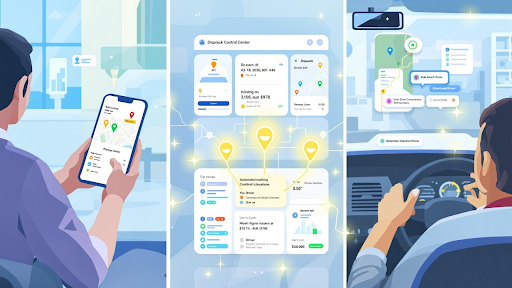
A fleet without central dispatch wastes vehicles even when demand is high. Jobs exist, drivers are available, but they do not meet at the right time. That gap is where efficiency is lost.
Demand Is Captured Instead of Missed
Centralised dispatch systems pull requests into one place. Phone calls, app bookings, and operator entries all feed into the same queue. This matters because demand is no longer scattered. When requests are fragmented, some drivers stay idle while others are overloaded. A single dispatch view prevents that imbalance.
The system can assign the nearest available driver or the one best suited for the job. Fewer requests slip through. Fewer drivers cruise without purpose.
Allocation Becomes Rule-Based, Not Guess-Based
Manual assignment depends on judgement in the moment. That can work at a small scale, but it breaks as volume increases. Centralised dispatch replaces that with rules. Distance, availability, vehicle type, and driver status can all be factored into assignment logic.
This does not remove human control. It removes randomness. Jobs are distributed using consistent criteria, which keeps the fleet balanced across busy periods.
Idle Time Is Reduced Across the Network
Idle time is rarely visible when each driver operates independently. It becomes clear when viewed centrally. Dispatch systems can show which vehicles are active, waiting, or moving toward a job.
With that visibility, idle vehicles can be redirected. Drivers can be moved toward areas with rising demand before requests peak. This turns idle time into repositioning rather than waiting.
Routing Decisions Improve Under Load
When multiple jobs are active, routing becomes more complex. Centralised systems can layer job assignments with route suggestions, helping drivers avoid unnecessary overlap or congestion.
For example, two drivers heading toward nearby pick-ups can be reassigned to prevent crossing paths. That small adjustment saves time and reduces traffic exposure across the fleet.
Communication Becomes Structured
Without central dispatch, communication is fragmented. Drivers rely on calls or messages that may be delayed or unclear. A central system standardises this flow. Job details, updates, and changes are delivered through one channel.
This reduces confusion. Drivers receive the same type of information in the same format. Dispatchers can track acknowledgements and progress without repeated follow-ups.
Coverage Aligns With Fleet Activity
Once several taxis are operating at the same time, risk stops being a one-vehicle issue. A delay, collision, or vehicle problem in one part of the operation can affect availability and coverage elsewhere. That is why taxi fleet insurance matters in a more practical sense. Taxi fleet insurance covers multiple taxis under one policy, with protection levels that can range from third-party to comprehensive depending on the level selected. The main point is that the risk sits across the full working fleet, not with one vehicle in isolation.
Centralised dispatch supports this by making fleet activity more predictable. When vehicles are assigned efficiently and monitored centrally, there are fewer rushed decisions and fewer unnecessary movements. That reduces how often risk escalates into incidents.
Performance Can Be Measured and Adjusted
A central system records everything. Job volume, response times, driver availability, and completion rates. This data allows managers to see where the operation slows down.
If certain areas consistently show delays, resources can be shifted. If specific times of day create bottlenecks, scheduling can be adjusted. Efficiency becomes something that can be improved deliberately, not guessed.
The Fleet Moves as One System
Without central dispatch, a taxi fleet behaves like separate units. Each driver works independently, and overall performance is inconsistent. With central dispatch, the fleet operates as a single system.
Vehicles are positioned based on demand. Jobs are assigned based on logic. Movement becomes coordinated rather than scattered.
In conclusion, taxi fleet insurance is there when incidents or disruptions affect the wider operation, but central dispatch helps prevent smaller inefficiencies from growing into bigger service problems. When vehicles, drivers, and bookings are managed through one system, the fleet runs with far less wasted movement and confusion.